

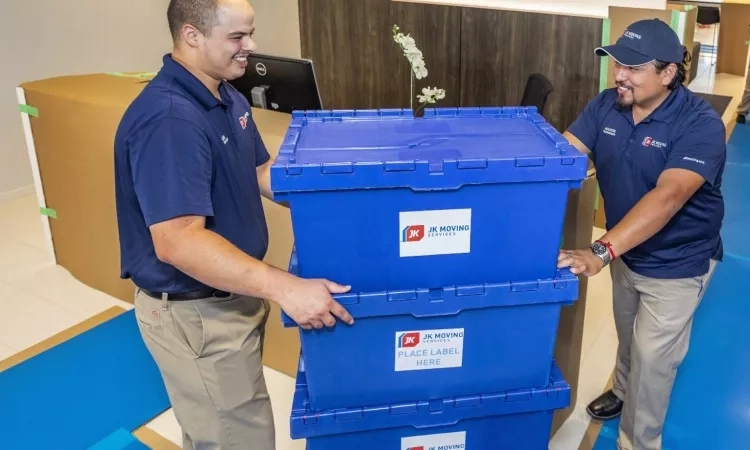
Proper labeling is the most important part of the move preparation. Labels tell the move team what to move and where each item belongs at your new location. Below are 5 office packing/labeling tips for your next move.
Tip #1: Labeling
All items moving must be labeled (i.e., furniture, computers, moving boxes, chairs, pictures, trash cans, floor mats, etc.). Your mover will assign each office, cubicle/workstation, work room, and open area a unique move number. This ensures all items are moved according to the floor plan. The move number should be written in the room section of the label (double-check you are writing the correct move number based on the color-coded move floor plan).
Use the piece section of the label along with the room placards. When moving multiple file cabinets, bookcases, or other identical furniture items, assign a specific letter to each piece. For example: 4A, 4B, 4C – This will allow for a set of files to be placed in a specific order.
Tip #2: Labeling pictures and whiteboards
Label pictures and whiteboards and leave them hanging on walls or stacked against the wall. These items will be packed and moved either in picture carts or commercial bins, using appropriate moving and packing materials. Small pictures that can fit into a crate should be bubble-wrapped and placed in a crate, ensuring the use of proper moving and packing materials for added protection during the move.
Tip #3: Labeling your filing cabinets, bookcases, shelving
- Two-drawer metal lateral filing cabinets (aka pedestals) can generally be moved full without emptying the contents.
- Pack the contents of four- or five-drawer metal lateral filing cabinets to avoid damage during the move.
- Wood filing cabinets must be emptied prior to the move.
- If your furniture has a push lock but no key, wrap tape around the push lock to prevent it from accidentally locking during the move.
- Storage cabinets must be completely emptied prior to moving.
- Bookcases must be emptied before moving. For bookcases that have removable shelves, remove and label each shelf, and place them on the floor. Also label the top of the bookcase and place shelf pegs in a plastic bag.
- Empty shelving prior to moving. If the shelving unit needs to be disassembled and reassembled, your mover will perform this work unless prior arrangements have been made. Place the clips in a sealed plastic bag or envelope and pack. Label each shelf and place it on the floor.
Labeling cabinets correctly and following office move packing instructions are key to relocating everything efficiently and without damage.
Tip #4: Packing crates for office supplies
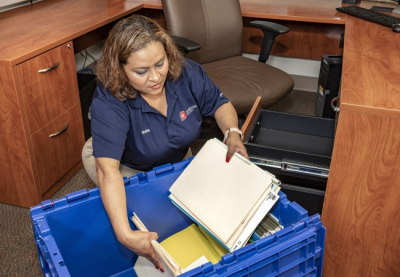
Plastic, reusable crates are ideal for office packing. These stackable containers simplify the packing process and provide excellent protection for your office equipment. Here are some move packing tips for using crates:
- Start by placing the first crate on a dolly.
- Pack each crate fully, then close the lid and stack the next crate on top. Continue until you have stacked a maximum of four crates.
- Pack loose items like pens or paper clips in plastic bags and place them inside the crates.
- Label each crate on the narrow end for easy identification during the move.
Using these crates helps keep your office equipment remains safe throughout the move.
Tip #5: Packing boxes for office moves
To help prevent boxes from being crushed, please fill the box completely. Seal the box properly and place one moving label on the narrow end of the box. Do not pack breakable items such as computers, baskets, or pictures in boxes, and don’t place already packed boxes into the crates. Instead, label each box directly for the movers to relocate.
Maximizing efficiency during your office move
These five simple office packing and labeling tips help minimize confusion and maximize efficiency on move day. Your company’s equipment, furniture, and belongings will arrive exactly where they need to be in your new office.
FAQs: How to pack for an office move
How do you pack up an office for moving?
Start by labeling everything. From computers to office furniture, clearly mark each item with its assigned move number. Use proper packing materials like crates for smaller items and padding for fragile equipment. Work with professional moving services to ensure the process goes smoothly.
How to pack office supplies professionally?
Professional packing requires a clear system: label everything, use durable packing materials, and plan your packing order carefully. Follow a packing checklist to ensure you don’t overlook any details, and consult with your moving company for expert moving packing tips.