


A lab that moves in April usually succeeds or struggles because of decisions made in October. Unlike an office, a lab can’t simply be packed up over a weekend. Freezers need backup plans, chemicals need to be sorted and cleared, and some instruments can only be disconnected or recertified by the manufacturer’s own technicians.
That’s why laboratory relocation planning for a spring move should start in the fourth quarter. Here’s what to get done before the new year, and how the months between now and move day typically come together.
Why Q4 is the right time to start planning
Budgets get set now. Many organizations finalize next year’s budgets in the fall. If the relocation, new equipment, or temporary storage aren’t in that budget, you may be asking for money mid-year, when it’s harder to find. Getting a realistic estimate in Q4 gives finance a real number to plan around.
Lead times are longer than they look. Manufacturer technicians for specialized instruments often book weeks out. Biosafety cabinets typically need to be decontaminated before they move and recertified after, and the University of Wisconsin–Madison’s lab move guidelines are one example of how much coordination that involves. Starting early gets your lab on those calendars before spring fills up.
The holidays slow everything down. Vendors, facilities teams, and researchers all take time off in late December. Decisions that need several sign-offs move faster in October and November than in January.
Tip: Name one move coordinator for the lab now. Having a single point of contact for facilities, safety, IT, and the movers keeps questions from bouncing between inboxes for months.
A Q4-to-spring timeline
Every lab is different, and a lab with hazardous materials or many specialized instruments may need more time. As one example, the University of Georgia’s decommissioning guidelines note that even a small-scale lab decommissioning generally takes about 60 days. For a typical spring move, the months tend to break down like this:
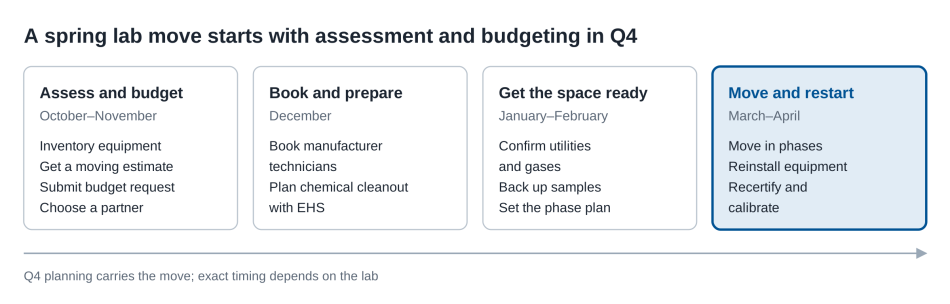
The heaviest decisions come first. By the end of December, you should know what’s moving, what it will cost, and who is handling each piece.
Get safety and facilities involved early
Your environmental health and safety (EHS) team will likely need to clear the lab before anything moves. That often means updating the chemical inventory, disposing of expired or unneeded materials, and decontaminating equipment and work surfaces. A lab move is a good time to clean house, and it means fewer hazardous materials to pack. Our guide to safely transporting lab chemicals covers what to expect for the materials you keep.
The new space needs the same attention. To ensure your freezers and incubators are operational on day one, confirm power and backup circuits as well as gas lines and ventilation well before move day. If the building isn’t ready, your team ends up waiting on an empty lab.
Tip: Walk the new lab with your facilities team and your moving partner in January. Measure doorways, elevators, and bench spaces for your largest instruments while there’s still time to adjust.
Keep the research going
Your lab can’t afford to go dark for weeks. A phased move will help you keep things running. Your support equipment and stored materials can be moved first, then review your active work schedule. Move this work in planned stages so experiments can wrap up or pause on schedule. Decide early which samples need backup storage or temperature-controlled transport, and who will check on them during the move.
This is also where choosing an experienced lab moving partner matters. Ask any mover you’re considering about their lab experience, how they handle sensitive instruments, and how they track every asset from disconnection to reinstallation.
Tip: Talk with researchers about their experiment schedules before you set move dates. A two-week shift in October can save a month of lost work in April.
Summary
A spring lab move is shaped by what happens in the fall. By starting your laboratory relocation planning in Q4, you’re able to include the move in next year’s budget and book specialized technicians before their calendars fill. Your safety and facilities teams also have plenty of time to prepare both spaces. By January, the plan is set, and the months before move day are about getting ready rather than catching up.