


For the facilities director or project office lead managing a clinical transition, the challenge isn’t just logistical, it’s operational. Medical equipment is specialized, often irreplaceable, and in many cases still needed for patient care right up until the moment it’s packed. Timelines are constrained by clinical schedules, not moving calendars. And the consequences of a poorly managed transition aren’t just financial. They affect staff, patients, and the continuity of care.
Hospital and clinic construction spending is projected to reach $30.7 billion in 2026, and fifteen new hospital projects costing more than $1 billion were announced in 2025 alone. For the teams responsible for managing those transitions, that scale of activity raises a straightforward question: what does a mover actually need to demonstrate before being trusted with a clinical environment?
Why medical facility moves are in a category of their own
Healthcare is shifting away from the centralized hospital model, with ambulatory surgery centers, cancer treatment centers, medical office buildings, and acute-care facilities increasingly decentralizing services from main campuses. Each of those transitions involves equipment that must be transported, reinstalled, and validated before it can be used again, including imaging systems, surgical robots, sterilization devices, and monitoring equipment that require handlers who understand not just how to move them, but how to document and protect them through every phase of the process.
That documentation layer is where many transitions break down. A well-managed healthcare move isn’t just physically careful, it’s administratively traceable. Chain-of-custody records, phased handoff documentation, and installation readiness checkpoints aren’t administrative formalities; they’re the audit trail that gives clinical leadership confidence that nothing was lost, mishandled, or installed out of sequence. For a COO or clinical operations lead evaluating a complex transition, that level of documented accountability is as important as the physical capability to move the equipment safely.
The role of furniture, fixtures, and equipment logistics
One area that consistently gets underestimated in healthcare facility moves is FFE (furniture, fixtures, and equipment) particularly in clinical settings. A new or renovated facility isn’t operational until every piece of equipment is in place, tested, and ready for use. That requires logistics coordination that goes well beyond standard moving services: phased delivery scheduling that aligns with construction completion floors, staging coordination to keep corridors and active units accessible, and sequenced installation planning developed in close coordination with clinical staff.
Matt Logan, Vice President of Sales and Business Development at JK Moving, has spent more than 30 years working in commercial relocation with significant focus on healthcare facility transitions. “Our expertise in regulations, safety compliance, and meticulous documentation ensures a secure and reliable move,” he says. “We bring the perfect combination of planning and execution, with onsite experience to handle every aspect.”
Equipment matters as much as expertise
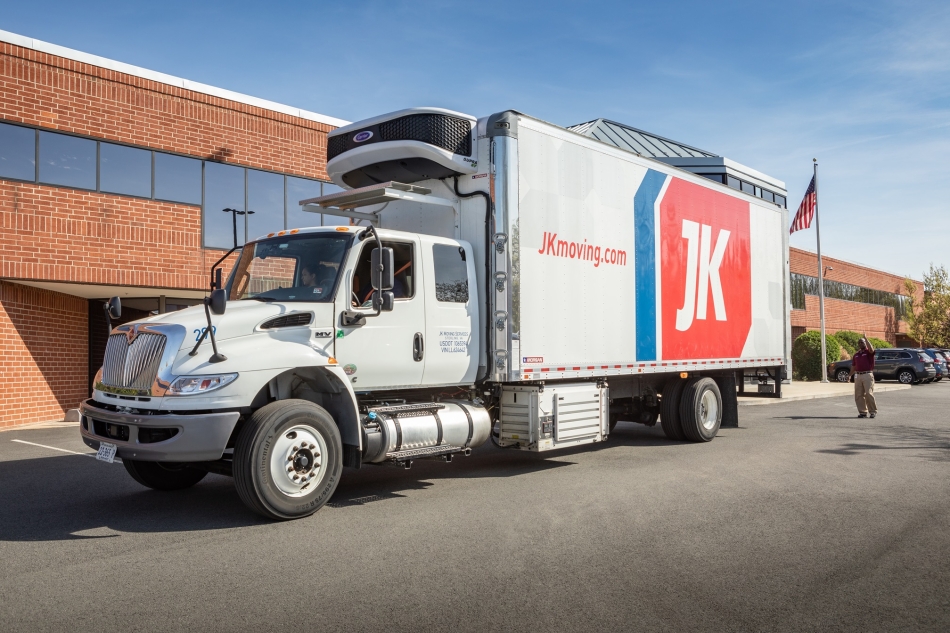 The transportation of medical equipment requires a high level of expertise. Healthcare logistics demand precision, reliability, and expert handling. That’s true at every stage, from packing and loading to transit and reinstallation.
Temperature-controlled transport is one area where specialized equipment makes a measurable difference. Climate-controlled vehicles with primary and backup generators (capable of powering both 120v and 240v equipment) allow sensitive instruments to remain powered and within specification throughout transit, not just at origin and destination. In practice, this means that equipment arriving at a new facility is ready for validation testing immediately, rather than requiring additional stabilization time before clinical use can resume.
Experience and staff tenure make a difference
Movers handling healthcare logistics undergo extensive training in handling fragile medical equipment, hazardous materials, and bio-sensitive supplies. But training alone doesn’t build the judgment that comes from years of hands-on experience in clinical environments. In an industry where staff turnover is common, the long tenure of a relocation team matters. The difference between a team that has navigated hundreds of hospital transitions and one that hasn’t tends to show up in exactly the moments that matter most, like when a phased schedule shifts, when an active unit needs to stay operational longer than planned, or when an installation sequence needs to be renegotiated in real time.
“Our people have developed the experience and the confidence to move a single piece of equipment or an entire facility,” Logan says. “We have the onsite management expertise as well as the bench strength and resources in project management.”
Planning is the foundation
The relocation of a hospital unit is a complex process that demands both formal planning and informal self-organization on the spot to cope with unexpected events under time pressure. For the facilities director or project office lead managing a clinical transition, the planning process starts well before a mover is ever contracted. It requires early engagement with clinical leadership, detailed equipment inventories, phased move planning that keeps critical services operational, and clear documentation protocols at every stage.
The planning deliverables that matter most in a complex healthcare transition include a disruption-minimization plan developed in coordination with clinical operations, a stakeholder coordination framework that accounts for nursing leadership, facilities, and procurement, and an installation readiness checklist that maps each equipment category to its validation requirements before clinical use resumes. The more rigorously those artifacts are developed upfront, the less likely it is that anything unexpected derails the timeline or compromises care continuity.
As Logan puts it: “JK’s strength is the depth of our expertise with the breadth to handle any project.”