


Every dollar sitting in a warehouse as unsold inventory is a dollar that isn’t working for your business. Rent, utilities, insurance, labor, and stock that slowly becomes outdated or unsellable all stack up the longer it sits on a shelf. Just-in-time (JIT) inventory management is built to solve exactly that problem. And the right storage partner can make the difference between JIT being a theoretical best practice and something your business actually runs on.
What just-in-time inventory actually means
Just-in-time inventory is a strategy built around receiving goods only as they’re needed for production or fulfillment, rather than stockpiling large quantities in advance. The approach traces back to Toyota, where founder Kiichiro Toyoda’s original guiding idea was that the best way to gather automotive parts was to receive them just in time for assembly – a concept that became one of the two foundational pillars of the Toyota Production System. What started on a Japanese assembly line in the mid-20th century has since been adopted across manufacturing, retail, healthcare, and technology, wherever companies want to match supply to actual demand rather than a forecast.
The core trade-off is straightforward: JIT reduces the capital tied up in inventory and the costs of storing it, in exchange for needing tighter coordination with suppliers and less cushion if something goes wrong. That trade-off is exactly where flexible, professionally managed storage becomes valuable. It lets a business get the cost benefits of JIT without carrying all of the operational risk itself.
The real cost of holding inventory you don’t need yet
The financial case for JIT gets clearer once you look at what unsold inventory actually costs. Inventory carrying costs are made up of the capital tied up in inventory, storage space, insurance, taxes, administrative handling, shrinkage, and lost value over time. According to industry benchmarking data from Fishbowl, most businesses see these costs land somewhere between 20% and 30% of total inventory value per year. On a $500,000 inventory, that’s $100,000 to $150,000 spent annually just to hold onto stock before it’s ever sold.
That’s the math JIT is designed to attack. Every SKU sitting in a warehouse “just in case” is quietly generating carrying costs (capital costs, space costs, risk of obsolescence) whether or not it ever gets used. Reducing that footprint, even partially, has a direct and measurable impact on the bottom line.
Why storage strategy makes or breaks a JIT approach
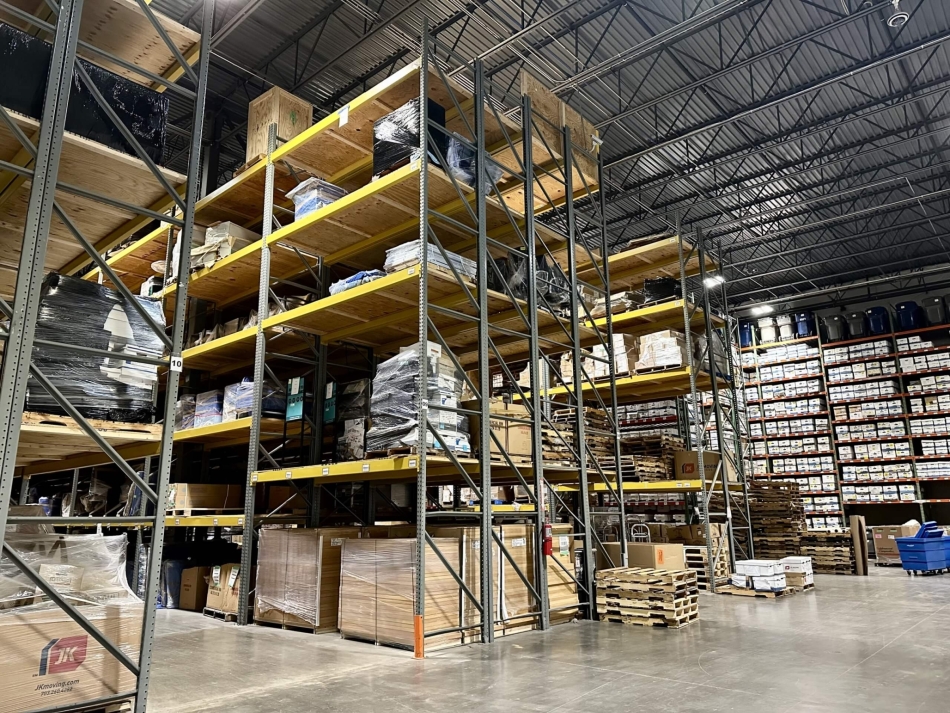 The challenge most businesses run into is that JIT sounds simpler on paper than it is in practice. Cutting inventory too aggressively without a reliable receiving, storage, and distribution partner can leave a company exposed the moment demand shifts or a shipment is delayed. This is where a flexible warehousing partner can help. Rather than owning and maintaining permanent warehouse space sized for your busiest month of the year, a business can scale storage up or down as actual demand requires.
Warehousing and logistics services should be built around this exact problem – receiving, storing, and delivering inventory, equipment, and FF&E on a client’s schedule rather than a fixed one. For businesses trying to keep JIT principles intact without taking on the risk of a stockout, that kind of scalable receiving and distribution model is often the missing piece.
Matching storage type to your inventory strategy
Not every JIT operation needs the same kind of space. For example, a manufacturer receiving daily component shipments has very different needs than a retailer managing seasonal inventory swings or a healthcare provider storing equipment before a facility move. Storage is the ideal solution when you need secure space without ongoing logistics. Warehousing makes more sense if your inventory needs active management (receiving, tracking, and distribution) as part of daily operations.
For businesses managing real-time inventory needs, look for a commercial storage partner that offers climate-controlled, government-rated facilities with real-time digital inventory tracking, so you’ll always know exactly what you have on hand and where it is – a baseline requirement for any JIT strategy to work reliably.
Making JIT work without the risk
Just-in-time inventory isn’t about eliminating storage, it’s about being deliberate with it. The businesses that get the most out of JIT are the ones that pair lean inventory practices with a storage and logistics partner flexible enough to scale with actual demand, rather than trying to predict it months in advance. Done well, that combination cuts carrying costs, frees up capital, and keeps operations running smoothly even when demand shifts.
If your business is evaluating how to reduce warehouse costs without compromising fulfillment speed, look for an experienced warehousing and logistics partner to help you find the right balance between lean inventory and reliable, scalable storage.